Have Manhattan Real Estate Prices Bottomed?
Posted by Wei Min Tan on June 22, 2026


One of the most common questions our investor clients ask is:
“Have Manhattan real estate prices finally bottomed?”
Based on recent market data, the better question may be: “Did Manhattan already bottom several years ago?”
The answer depends on the segment of the market being analyzed, but recent condominium data suggests that Manhattan has moved well beyond the correction phase that began in 2017.
In fact, first-quarter 2026 data established new records for both median sale price and average price per square foot in the Manhattan condominium market.
For investors who have been waiting for a significant pullback, these developments deserve attention.

Read about Wei Min’s style in Best Manhattan property agents and Role of a buyer’s broker.
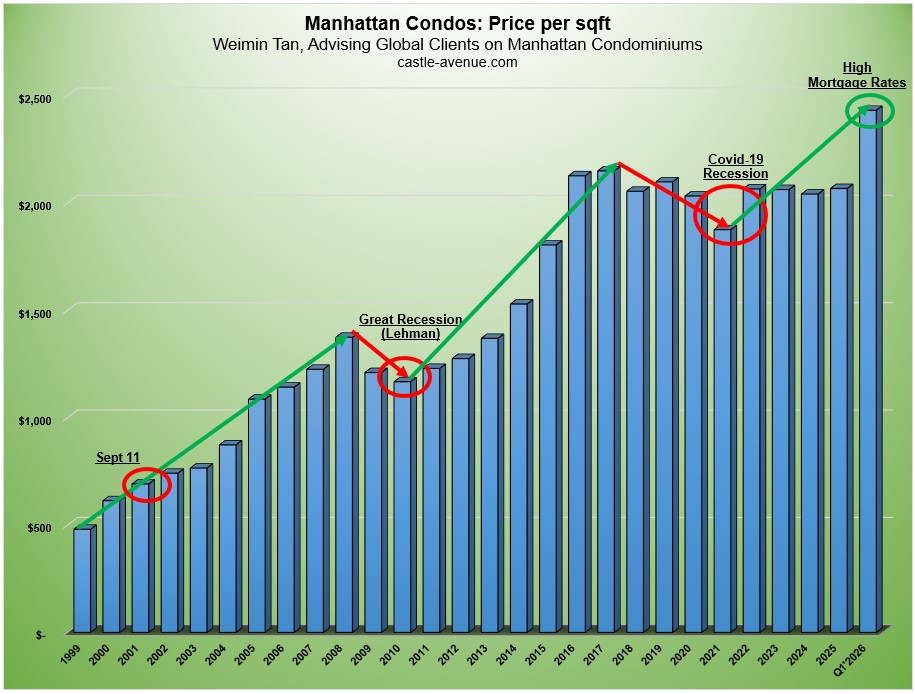
Weimin’s article, Manhattan condo historical price trend.
A Decade-Long Market Cycle
To understand where Manhattan stands today, it is helpful to look at the broader market cycle.
Manhattan condominium prices reached a prior peak in 2017.
What followed was a multi-year correction that lasted through 2020.
During that period, the market faced several challenges:
-
- Increased new development inventory
- Slowing transaction activity
- Changes in buyer sentiment
- Economic uncertainty
- The disruptions associated with the COVID pandemic
Many buyers expected the correction to continue for years. There was talk about “death of big cities” etc.
Instead, the market began recovering in 2021.
Over the next several years, condominium prices gradually rebuilt the ground lost during the correction.
By the first quarter of 2026, Manhattan condominiums had not only recovered—they had surpassed prior highs.
The average condominium price per square foot reached a record $2,431 in Q1’2026.
Median sale prices also reached a new record.
This is significant because it represents more than a short-term rebound. It marks the completion of a nearly decade-long market cycle.
What the Data Suggests
Market bottoms are only obvious in hindsight.
In retrospect, the data increasingly suggests that the low point for much of the Manhattan condominium market occurred years ago rather than today.
That does not mean prices will rise in a straight line from here.
Real estate markets rarely move that way.
However, it does suggest that investors waiting for a repeat of the 2017-2020 correction may be waiting for conditions that no longer exist.
The market environment today is fundamentally different.
Wei Min’s article, Is now a good time to invest in Manhattan, New York residential property?
Why Manhattan Has Been More Resilient Than Expected
Several structural factors continue to support the Manhattan condominium market.
Limited Supply
Unlike many cities, Manhattan cannot simply expand outward.
Development sites are limited.
Zoning constraints are significant.
Many desirable neighborhoods are largely built out.
This natural scarcity has historically supported long-term values.
Strong Demand for High-Quality Assets
The strongest-performing properties are typically those with characteristics that are difficult to replicate:
-
- Prime locations
- Strong building reputation
- Desirable layouts
- Financially sound condominium structures
- Broad market appeal
These assets tend to recover first following market downturns.
Global Capital Appeal
Manhattan remains one of the world’s most recognized residential real estate markets.
Investors continue to value:
-
- Property rights
- Market transparency
- Liquidity
- Economic diversity
- Global connectivity
These characteristics help support demand across multiple market cycles.
Deal example: Four Seasons Downtown in Tribeca. Buyer client purchased at significant discount to original price. Rented out in 1 day with 4 offers, all over the $20,000 asking rent.

Not Every Property Has Recovered Equally
It is important to recognize that record market statistics do not mean every apartment has appreciated.
There is often a substantial difference between average assets and exceptional assets.
Some properties continue to face challenges related to:
-
- Location
- Building quality
- Excessive carrying costs
- Functional obsolescence
- Oversupply
This is why asset selection remains critically important.
A rising market does not eliminate the need for disciplined underwriting.
The Risk of Waiting for the Perfect Bottom
Many investors attempt to identify the exact bottom before committing capital.
The challenge is that market bottoms are rarely recognizable in real time.
When opportunities are most attractive, uncertainty is often highest.
By the time the market establishes new pricing records, many of the best opportunities have already passed.
The investors who acquired quality Manhattan condominiums between 2019 and 2021 did not know they were buying near the bottom.
They simply recognized that valuations had become more attractive relative to long-term fundamentals.
View from a client’s holiday condo. This was a new development project. Booked at pre-construction stage and we waited for completion.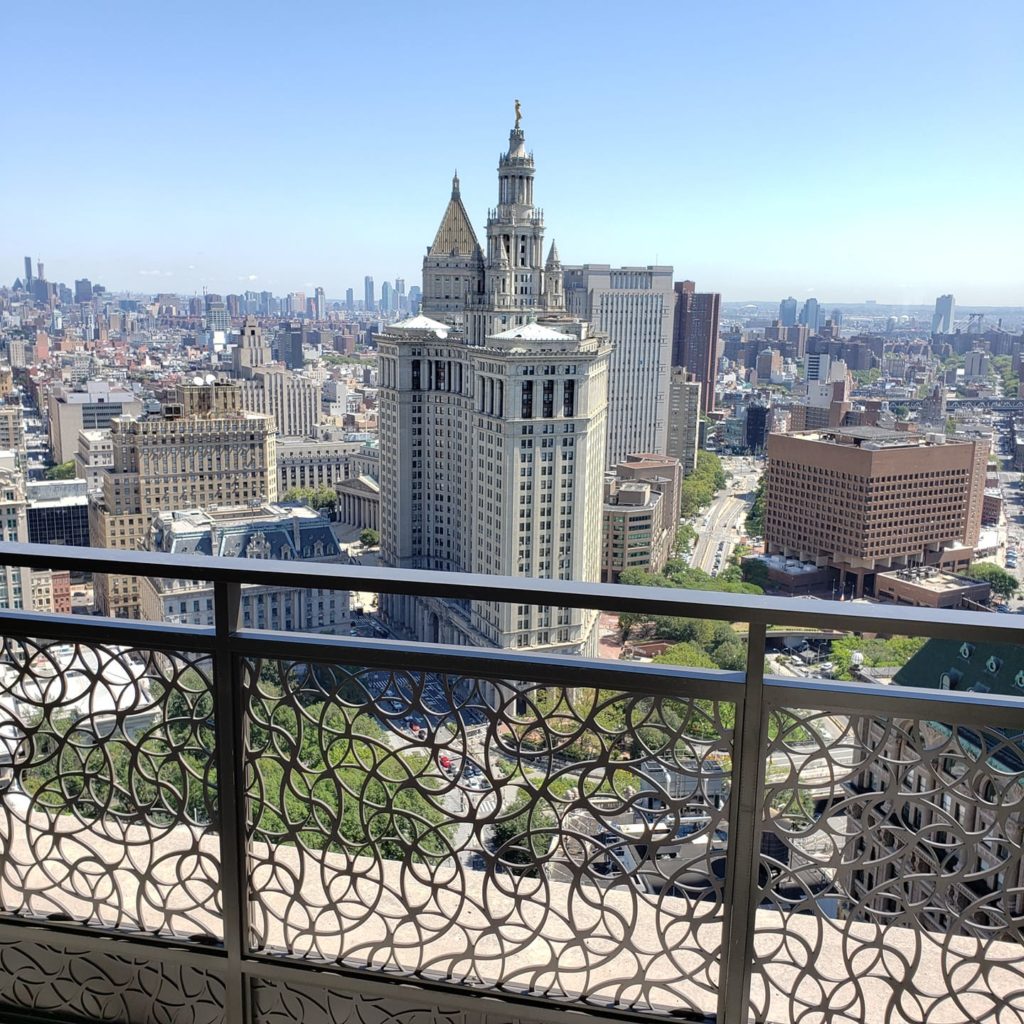
The More Important Question
Rather than asking whether Manhattan has bottomed, investors may benefit from asking:
“Am I purchasing a high-quality asset that I would be comfortable owning for the next decade?”
For long-term investors, factors such as:
-
- Location
- Scarcity
- Liquidity
- Building quality
- Rental demand
- Financial strength of the condominium
often matter more than attempting to predict short-term price movements.
Final Thoughts
The historical data tells a compelling story.
Manhattan condominium prices peaked in 2017.
The market corrected between 2017 and 2020.
A recovery began in 2021.
By the first quarter of 2026, both median sale prices and average price per square foot had reached new record highs, with condominium values averaging $2,431 per square foot.
No one can predict future market movements with certainty.
However, the evidence suggests that Manhattan’s condominium market is no longer searching for a bottom.
The more relevant question for investors today is whether the assets they are evaluating possess the characteristics that have historically driven long-term value creation.
As with most successful investments, the focus should not be on perfectly timing the market.
It should be on owning exceptional assets through multiple market cycles.
What We Do
We focus on global investors buying Manhattan condos for portfolio diversification and long term return-on-investment.
1) Identify the right buy based on objectives
2) Manage the buy process
3) Rent out the property
4) Manage tenants
5) Market the property at the eventual sale